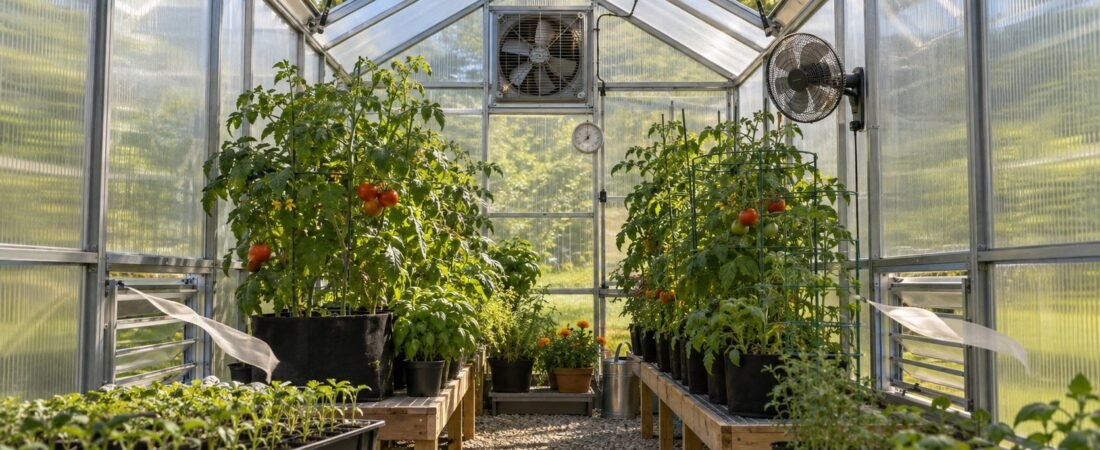
Sunlight can quickly raise greenhouse temperatures, even when the outdoor air feels mild. Ventilation removes hot, humid air and replaces it with outside air. It also helps manage condensation and supports the exchange of carbon dioxide that plants use.
No single vent count suits every greenhouse. Required capacity depends on floor area, interior volume, glazing, climate, sun exposure, shade, plant density, and whether the system relies on natural openings or powered fans.
Natural ventilation
Natural ventilation uses roof vents, ridge vents, and lower side or end openings. Warm air rises and escapes high in the structure while cooler outside air enters lower down. Larger vertical separation and unobstructed openings generally improve this stack effect; wind can help or hinder it.
Small decorative vents may not provide enough open area during hot weather. Compare the net clear opening—not simply the outside dimensions of the vent—and consider insect screening, which adds resistance to airflow. Automatic wax-cylinder openers can operate roof vents without electricity, but they still need correct adjustment and periodic inspection.
Fan ventilation
A powered exhaust system normally places fans high on one end or side and intake shutters on the opposite side. The goal is to pull outside air across the growing area without leaving stagnant corners. Intake openings must be large enough to supply the fan; undersized intakes reduce airflow and increase pressure on the equipment.
University greenhouse guidance commonly sizes summer mechanical ventilation around frequent complete air replacement, often approximately one greenhouse volume per minute under design conditions. That is a starting point, not a universal shopping rule. Screens, shutters, ducting, altitude, greenhouse shape, and fan performance under static pressure can change the result.
Air exchange is not the same as air circulation
Ventilation exchanges indoor and outdoor air. Horizontal-airflow or circulation fans mix the air already inside. Circulation helps reduce temperature layers, damp pockets, and condensation around foliage, but it does not remove solar heat on its own.
Fans should create gentle, continuous movement through the crop rather than a harsh stream aimed at nearby plants. Equipment placement changes as plants grow and benches fill, so check for dead zones throughout the season.
Ventilation has limits
When the outside air is nearly as hot as the desired greenhouse temperature, ventilation alone cannot provide substantial cooling below outdoor temperature. Shade cloth reduces solar gain, and evaporative cooling may help in dry climates. In humid regions, evaporative systems are less effective.
Heating season also requires controlled fresh air and circulation, but excessive ventilation wastes heat. Automated controls can stage vents, fans, heaters, and cooling equipment so they do not fight one another.
What to compare before buying
- Total net vent opening and the balance between high outlets and low inlets
- Fan airflow at the pressure created by shutters and insect screens
- Thermostat or environmental-controller range and sensor placement
- Backup operation or alarms if plants depend on powered cooling
- Weather protection for fans, motors, wiring, and controls
- Replacement parts for vent openers, louvers, belts, motors, and sensors
- Noise and vibration near neighboring homes or sleeping areas
- Safeguards over accessible fan blades and moving equipment
Plan for failures
A stuck vent, power outage, tripped breaker, or failed thermostat can become serious quickly on a sunny day. Inspect moving parts regularly and make sure doors or vents can be opened manually. If the greenhouse contains valuable or temperature-sensitive plants, consider an independent high-temperature alert.
A qualified professional should design and install electrical work in a wet greenhouse environment under applicable codes. Follow equipment instructions and keep cords, controls, and connections away from irrigation and standing water.
For the broader environmental plan, visit Setup and Climate Control. Site exposure and shade are covered in Best Location for a Backyard Greenhouse.