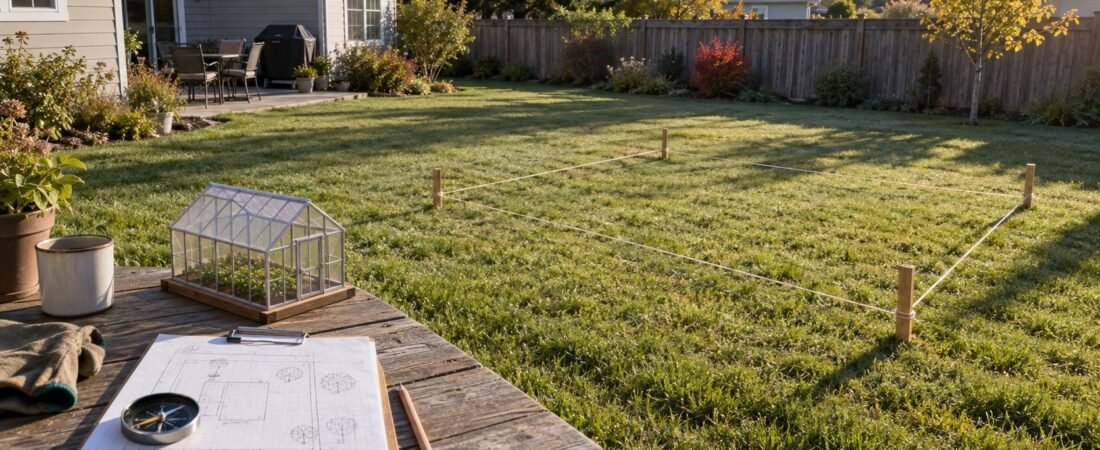
Greenhouse orientation is the direction of its ridge or longest dimension. Orientation advice can sound contradictory because the best answer changes with latitude, season, greenhouse shape, nearby shade, and how plants are arranged inside.
For a backyard greenhouse, the first priority is usually to place the structure where it receives useful sunlight during the intended growing season. A theoretically ideal compass direction will not overcome shade from a house, evergreen trees, or a neighboring building.
Start with the months you plan to grow
If winter and early spring production are important, low-angle winter sunlight deserves special attention. A south or southeast exposure is often favored for access to winter sun, with morning light particularly valuable after a cold night. Observe the site rather than relying only on a compass.
For mostly summer use, overheating may become the larger problem. Orientation still affects light distribution, but shade, vent capacity, prevailing wind, and cooling equipment may have greater practical impact.
Ridge direction and light distribution
An east–west ridge presents a broad roof slope toward the south in the Northern Hemisphere and can favor winter light capture in some situations. A north–south ridge allows the sun’s path to move across both sides of the structure, often producing more even daily light distribution during brighter seasons.
These are tendencies, not absolute rules. Roof pitch, framing shadows, glazing diffusion, latitude, crop height, and interior benches all influence the light that reaches plants.
Let the yard constrain the answer
The long side of a greenhouse may need to follow a property line, slope, access route, or utility connection. That can be a sensible compromise if the chosen location remains sunny and well-drained. Don’t rotate a greenhouse into an awkward position just to satisfy a general orientation rule.
Leave enough clearance for installation, cleaning, roof runoff, snow removal, vent operation, and future repairs. Also verify setbacks and easements before treating an orientation as final.
Wind and snow also matter
Orientation changes which walls and roof edges face prevailing winds. Doors and large vents should not become obvious weak points during storms. In snow country, drifting, roof shedding, and snow sliding from nearby buildings can influence placement.
The manufacturer’s structural instructions and local conditions take priority over informal advice. Anchor and assemble a greenhouse for its rated loads, regardless of direction.
A practical way to decide
- Map shadows at several times of day during the least sunny growing months.
- Compare two or more possible footprints, including exterior working clearance.
- Mark the ridge, doors, roof vents, benches, and tall crops on the plan.
- Consider winter light, summer overheating, prevailing wind, and snow together.
- Choose the arrangement that provides dependable light without compromising drainage, access, utilities, or local rules.
Orientation is one part of site selection. Read Best Location for a Backyard Greenhouse, then use Plan Your Greenhouse to coordinate the remaining decisions.