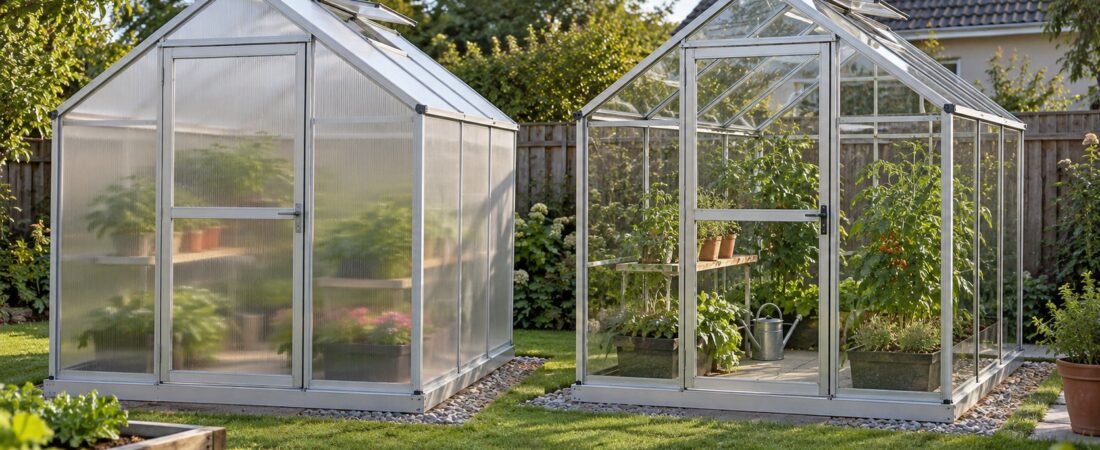
The glazing is the transparent or translucent material covering a greenhouse. It affects far more than appearance: light transmission, heat loss, summer temperature, structural weight, maintenance, and replacement cost all depend partly on this choice.
Glass and multiwall polycarbonate are two of the most common rigid options for backyard greenhouses. Neither is automatically best. Glass is valued for clarity, longevity, and a traditional appearance, while polycarbonate is lighter, more impact-resistant, and often easier to insulate.
How glass performs
Clear horticultural glass admits abundant direct light and preserves a crisp view into and out of the greenhouse. It resists scratching better than plastic glazing and can remain attractive for many years when the frame, seals, and panes are maintained.
Its disadvantages are weight, breakage risk, and heat loss when used as a single layer. Glass generally requires a stronger structure and careful installation. Tempered or otherwise safety-rated products can reduce injury risk, but replacement panels may still be expensive and difficult to handle.
Direct light passing through clear glass can also create sharp shadows and concentrated heat on sunny days. Depending on climate and crops, you may need shade cloth, interior screening, ventilation, or other cooling measures.
How polycarbonate performs
Greenhouse polycarbonate is normally sold as twin-wall or multiwall panels with air spaces between layers. Those channels improve insulation compared with a single thin covering and diffuse incoming light, spreading it more evenly around plant leaves.
Polycarbonate is much lighter than glass and resists impact from ordinary bumps and many hail events. It is therefore common in greenhouse kits that owners assemble themselves. The material can flex slightly, but it must be installed with the correct supports, expansion allowance, edge closures, and ultraviolet-protected side facing outward.
The trade-offs include less transparency, greater susceptibility to scratching, and gradual aging. Quality varies substantially. Thin panels, weak ultraviolet protection, poorly sealed channels, or inadequate framing can shorten service life.
Light: clarity is not the entire story
Manufacturers often emphasize the percentage of light transmitted through a panel, but plants also respond to how that light is distributed. Clear glass usually provides a brighter view and more direct light. Multiwall polycarbonate diffuses light, which may reduce deep shadows and distribute radiation across more leaf surfaces.
Compare published light-transmission information for the exact product rather than assuming every glass or polycarbonate panel performs alike. Tint, thickness, coatings, condensation, dirt, framing, and the number of layers all influence the result.
Insulation and condensation
Single-pane glass loses heat readily. Insulated glass units perform better but add cost and weight. Multiwall polycarbonate traps air within its flutes and is usually the more practical insulated option in hobby kits.
Any glazing system can develop condensation. Proper ventilation, air circulation, drainage, and temperature management matter. On polycarbonate, orient and seal the channels as the manufacturer directs so condensation can drain and dirt or insects don’t enter the cells.
Durability depends on the complete system
Do not evaluate panels separately from their frame and fastening method. A strong sheet can still fail if it pulls out of shallow grooves or if the structure twists in wind or snow. Ask whether the published wind and snow ratings apply to the entire assembled greenhouse, including its anchoring and foundation.
For polycarbonate, compare panel thickness, wall structure, ultraviolet warranty, fastener details, and replacement availability. For glass, identify the glass type and thickness, whether panes are safety-rated, and how they are retained in the frame.
Maintenance and repair
- Glass tolerates careful cleaning and resists scratches, but cracked panes need prompt replacement.
- Clean polycarbonate with products and tools approved by its manufacturer; abrasive cleaning can cloud or scratch it.
- Inspect multiwall panel edges and closures for moisture, algae, insects, and damaged tape.
- Both systems need clean gutters, sound seals, and periodic post-storm checks.
- Before buying, confirm that replacement panels or panes are standard sizes or can be ordered.
Which material fits which buyer?
Glass may be the better fit when traditional appearance, long-term clarity, and scratch resistance are priorities and the budget supports a heavier structure and professional-quality installation. It is especially appealing for a greenhouse that will be a prominent garden feature.
Polycarbonate is often the practical choice for a do-it-yourself kit, a colder climate, a hail-prone location, or a project where impact resistance and lower structural weight matter. Choose greenhouse-grade panels from a seller that provides meaningful specifications and a written warranty.
When comparing prices, look at the complete installed system. Foundation requirements, freight, replacement availability, shading, insulation, and structural strength can matter more than the initial difference between two kits.
For a broader comparison of shapes, frames, ventilation, ratings, and warranties, visit Choose a Greenhouse. Our Setup and Climate Control page covers the environmental systems that work with the glazing.