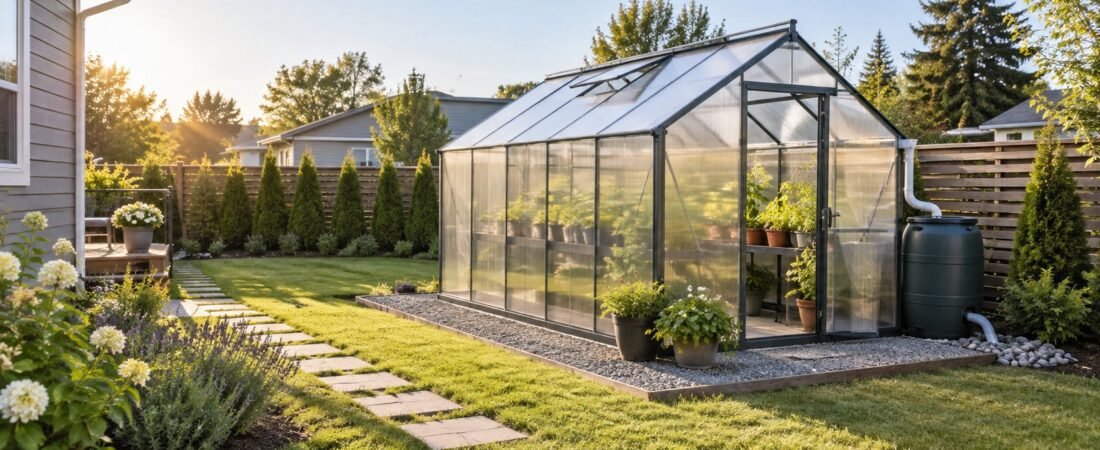
A good greenhouse cannot fully compensate for a poor site. Too much shade limits winter growing, trapped water creates foundation and humidity problems, and an inconvenient location can make routine care feel like a chore. Taking time to compare possible locations is one of the least expensive ways to improve the project.
The best site is usually a well-drained, nearly level area with dependable sunlight, reasonable protection from damaging wind, and convenient access to water and electricity. Few yards offer every advantage, so the goal is to identify which compromises can be corrected and which will remain permanent.
Observe sunlight through the seasons
A sunny spot in summer may be shaded in winter when the sun travels lower across the sky. Watch candidate locations at several times of day and, if possible, in more than one season. Buildings, fences, evergreen trees, and neighboring structures can block valuable winter light.
University extension guidance commonly favors a south or southeast exposure for winter sunlight, with an eastern exposure often considered the next choice. Local climate and your intended growing season still matter. In a very hot climate, modest afternoon shade may be useful, but heavy year-round shade is difficult to overcome.
Deciduous trees may appear less troublesome because they lose their leaves, yet branches still cast shade and can drop limbs, leaves, sap, and debris onto the glazing. Tree roots can also interfere with foundations and drainage.
Put drainage near the top of the checklist
Choose ground where rainwater naturally moves away from the greenhouse. A low area that stays wet after a storm can lead to muddy access, frost movement, algae, excess humidity, and foundation trouble. A slight natural slope can help, but a steep slope increases excavation and retaining costs.
Also consider where water from the greenhouse roof will go. Gutters and rain barrels can collect useful irrigation water, but overflow needs a safe route that will not erode the base or create a puddle beside the entrance.
Consider wind without sacrificing light
Strong wind stresses the frame, glazing, doors, and vents. A fence, hedge, or building can reduce exposure, provided it is far enough away to avoid substantial shade, drifting snow, or turbulent wind. Don’t rely on a weakly anchored greenhouse just because the yard feels sheltered; the structure and foundation still need to meet local conditions.
Walk around the site during windy weather. Gaps between buildings and narrow side yards can accelerate air rather than protect the greenhouse. Ask the manufacturer what wind rating applies, what foundation or anchoring system is required, and whether the rating depends on doors and vents being closed.
Make daily access easy
A greenhouse needs attention during temperature swings, not only on pleasant gardening days. A location close to the house may make it easier to open vents, check a heater, water plants, or respond to a storm. The route should remain safe when it is dark, wet, icy, or muddy.
Leave working clearance around the exterior. You may need to wash the glazing, repair panels, clear snow, maintain vents, or reach gutters. A greenhouse squeezed tightly against a fence can make ordinary maintenance unnecessarily difficult.
Plan water and electricity before construction
Carrying water by hand becomes tiring quickly. Determine whether a frost-protected supply line, hose, rainwater system, or other practical source can reach the greenhouse. If you plan fans, heaters, lights, pumps, or controls, have a qualified electrician determine the appropriate outdoor circuit and protection.
Extension cords are not a substitute for a properly designed permanent electrical supply. Moisture, irrigation, and condensation make a greenhouse a demanding environment for electrical equipment.
Check local rules and underground services
Before settling on a location, verify property-line setbacks, easements, height limits, lot-coverage rules, homeowner-association restrictions, and permit requirements. Rules vary by community and can depend on the greenhouse size, foundation, utilities, and whether it is treated as a permanent accessory structure.
Contact the local utility-marking service before excavation. A site that appears open may contain buried electric, gas, communications, water, irrigation, or drainage lines.
Compare sites with a simple scorecard
- Seasonal sunlight, especially during the months you plan to grow
- Drainage and the route of roof runoff
- Wind exposure and safe anchoring options
- Distance to water and electrical service
- A convenient, accessible path from the house
- Exterior clearance for construction and maintenance
- Setbacks, easements, permits, and neighborhood restrictions
- Risk from falling branches, snow sliding from roofs, or other overhead hazards
Once you select a location, use the Plan Your Greenhouse page to work through the remaining decisions. The Setup and Climate Control page explains why site conditions affect ventilation, heating, and cooling.