Choosing a backyard greenhouse involves more than finding a kit that fits the available space. The structure’s shape, frame material, glazing, ventilation design, weather ratings, expandability, and warranty can all affect performance and longevity. Understanding these differences makes it easier to compare greenhouses on practical value rather than appearance or price alone.
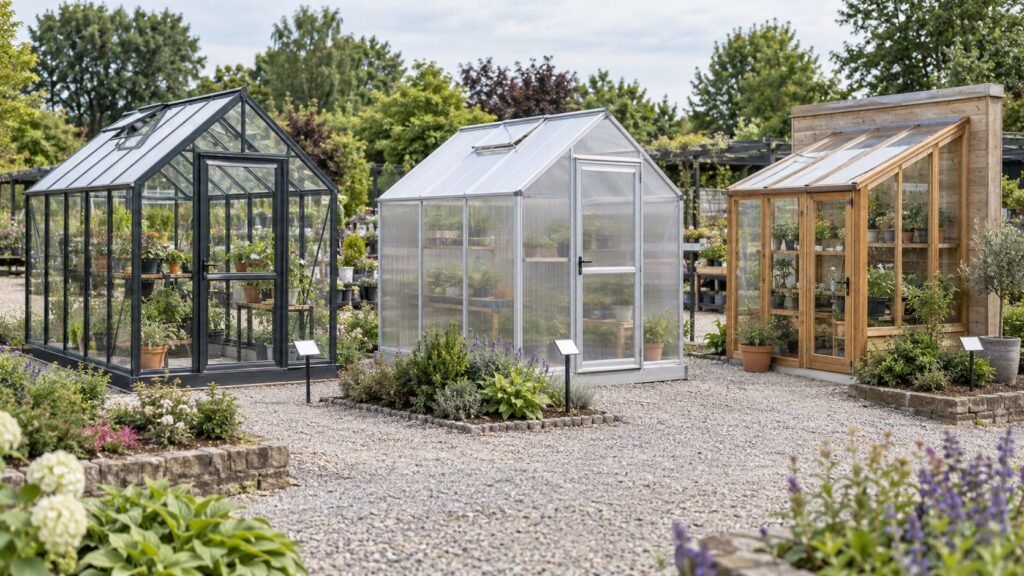
Compare the Main Greenhouse Styles
The best greenhouse style depends on the available space, intended use, climate, and budget. Most backyard buyers begin by comparing freestanding greenhouses, lean-to models, and hoop-style structures.
Freestanding Greenhouses
A freestanding greenhouse can be placed wherever sunlight, drainage, and access are most favorable. It receives light from every side and is available in many sizes and materials. Because all four walls and the roof are exposed to the weather, however, it may require more heating, anchoring, and structural protection than a greenhouse attached to another building.
Lean-To Greenhouses
A lean-to greenhouse shares one wall with a house, garage, or other structure. This can conserve yard space and make access to water and electricity more convenient. Its performance depends heavily on the wall’s direction, shadows from the building, roof drainage, and whether the attachment can be made safely without creating moisture problems.
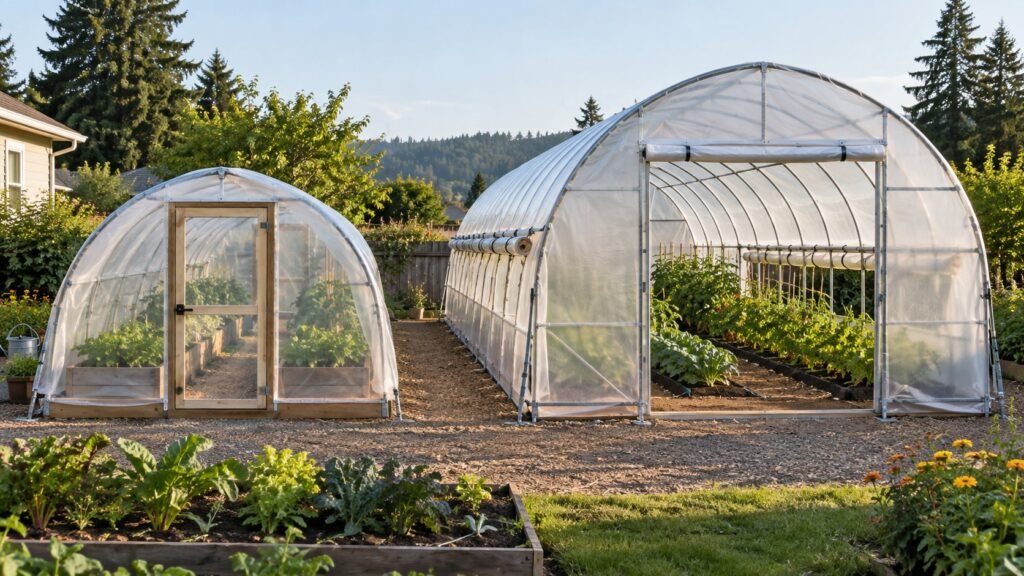
Hoop Houses and Tunnel Greenhouses
Hoop houses use curved framing covered with greenhouse film or another flexible material. They can provide substantial growing space at a comparatively low cost and are often practical for extending the season. Their coverings generally require more frequent replacement than rigid panels, and wind resistance, snow shedding, anchoring, and end-wall construction should be evaluated carefully.
Compare Greenhouse Frame Materials
The frame supports the greenhouse covering and carries wind and snow loads. Material alone does not determine strength—component thickness, support spacing, connections, engineering, and the anchoring system all matter.
Aluminum Frames
Aluminum is lightweight, rust-resistant, and commonly used in backyard greenhouse kits. It requires relatively little maintenance and can be easy to assemble, but lighter aluminum frames may need additional reinforcement in areas exposed to heavy snow or strong winds.
Galvanized Steel Frames
Galvanized steel is often chosen when structural strength is a priority. It is common in hoop houses and larger greenhouse systems and can perform well in demanding weather when properly engineered and anchored. Steel is heavier than aluminum, and cut edges or damaged coatings may require attention to limit corrosion.
Wood Frames
Wood offers a traditional appearance and can make shelving and other interior features easier to attach. It also requires protection from persistent moisture, insects, and decay. Consider the wood type, treatment method, construction quality, and ongoing maintenance before choosing a wooden greenhouse.
Compare Greenhouse Glazing Options
Glazing is the transparent or translucent material that covers the greenhouse. It affects light transmission, heat retention, durability, appearance, maintenance, and price. The best choice depends on how and when you will use the greenhouse.
Glass
Glass provides excellent clarity, a traditional appearance, and a long service life when properly maintained. It is also heavy, relatively expensive, and more vulnerable to breakage than many plastic materials. A glass greenhouse needs a frame and foundation designed to support its weight.
Polycarbonate Panels
Polycarbonate is widely used in backyard greenhouse kits because it is lighter and more impact-resistant than glass. Twin-wall and multiwall panels create insulating air spaces that can improve heat retention, although they provide a more diffused view. Compare panel thickness, ultraviolet protection, light transmission, warranty coverage, and how securely the panels attach to the frame.
Greenhouse Film
Greenhouse film is economical and commonly used on hoop houses and tunnel greenhouses. Specialized greenhouse-grade film offers better ultraviolet resistance and durability than ordinary plastic sheeting, but it still has a limited service life and will eventually require replacement. Double-layer systems with an inflated air space can provide better insulation than a single layer.
Match the Greenhouse to Your Weather
Don’t assume every greenhouse kit is designed for severe weather. Look for clearly stated wind and snow-load ratings, and compare those ratings with local conditions and building requirements. The frame strength, support spacing, panel attachment system, foundation, and anchoring method all work together.
Roof shape also affects weather performance. Steeper roofs generally shed snow more readily, while curved structures may handle wind differently from traditional straight-sided designs. Manufacturer ratings normally depend on correct assembly and anchoring, so review the installation requirements before treating any advertised rating as applicable to your project.
Evaluate the Ventilation Design
A greenhouse can overheat surprisingly quickly, even when the outdoor temperature feels comfortable. When comparing models, look at the number, size, and location of roof vents, side vents, doors, and other openings. Roof vents allow rising hot air to escape, while lower openings help draw cooler air into the structure.
Consider whether the greenhouse can accommodate automatic vent openers, circulation fans, exhaust fans, shade coverings, and insect screens. A low-priced kit may become less economical if its ventilation is inadequate or if adding the necessary equipment requires substantial modification.
Compare What the Kit Actually Includes
Review the complete parts list rather than assuming that similarly sized kits include the same equipment. Roof vents, automatic openers, base frames, anchoring hardware, doors, gutters, shelving, and shade systems may be standard with one greenhouse and optional with another. Delivery charges and assembly requirements can also substantially change the true cost.
Check whether the greenhouse can be extended later and whether replacement panels, seals, clips, vents, and other parts are readily available. Read the warranty carefully to see which components are covered, how long the coverage lasts, and whether exclusions apply to wind, snow, improper anchoring, installation errors, or normal deterioration.
Compare Total Value, Not Just Price
The best greenhouse is not necessarily the least expensive or the most elaborate. It is the one that fits the property, growing plans, climate, maintenance expectations, and complete project budget. Compare the structure and required accessories as a single working system so a lower initial price doesn’t lead to costly later modifications.